Wines With Attitude red logo

Wines With Attitude

Carmenère: Chile’s signature grape & wine

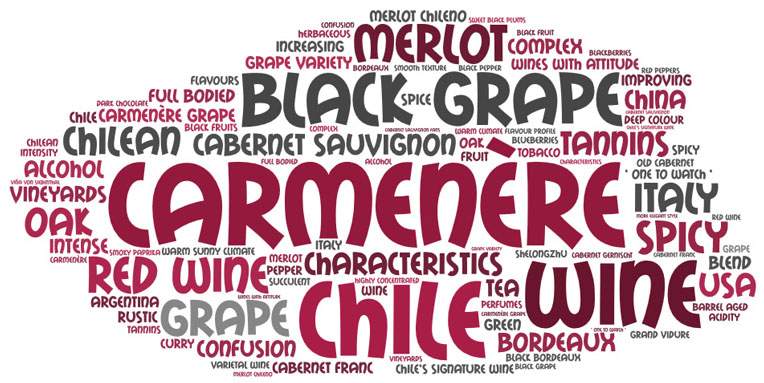
Word Art bubble about the Carmenere grape

You would not be surprised to learn that Cabernet Sauvignon, Pinot Noir, Chardonnay and other well-known grape varieties are popular search terms on the Wines With Attitude website. However, one of the most searched-for varieties is Carmenère (pronounced car-mun-air), a rather more obscure, though distinctive, black grape variety. Part of the reason for its low profile is that Carmenère accounts for only a tiny proportion of the total world wine grape production. In addition it has long been the source of mystery and misidentification. In fact the grape was almost extinct and was only rediscovered many years later, in the late 20th century, on a different continent having long been mistaken for another grape.

So why is Carmenère such a popular search term? Let’s delve into the mysterious Carménère and find out where it is grown, what kind of wines it produces, what it tastes like and why you should make it a part of your wine repertoire.

The Carmenère grape and its Origins

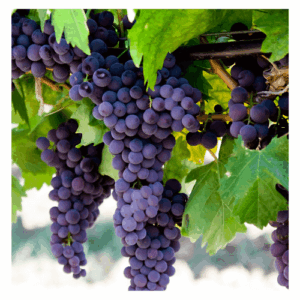
Carmenere grapes hanging on the vine

Despite Chile being considered the “home” of Carmenère, it may surprise you to learn that the grape actually originated in Bordeaux. It was held in such high esteem that in the 18th and 19th centuries, it was widely grown in the region alongside Cabernet Sauvignon and Merlot. Carmenère contributed deep colour and spice characteristics to Bordeaux blends up until phylloxera hit France. Phylloxera is a pest which obliterated many European vineyards during the 19th century The solution to phylloxera, eventually and widely adopted by the European wine industry, was to plant European grapes onto American rootstock but Carmenère did not adapt well to grafting. Other varieties fared better and, as a result, Carmenère fell out of favour and in fact was presumed to be extinct.
Confusion over Carmenère

It was only relatively recently found that Carmenère is directly related to Cabernet Franc and indirectly to Cabernet Sauvignon and Merlot. This fact goes some way to explaining why the Carmenère grape was lost for so long and the problems that many have had identifying it over the years.

According to the wine industry “grape bible”, ‘Wine Grapes’ (Robinson, Harding, Vouillamoz), cuttings of Carmenère and other Bordeaux native grapes were sent to Chile in the 1850s but it is believed that some Chilean growers did not distinguish Carmenère from Merlot and planted the two (and maybe more varieties) together in the same vineyards. Others who may have noticed a difference and dubbed Carmenère ‘Merlot Chileno’ did not produce varietal (100%) wine from it. It was only in 1998 that Chile recognised its beloved black grape variety as Carmenère after thorough DNA profiling. Before that (and probably since) much of the Chilean Merlot that was produced was undoubtedly Carmenère.

Just to add to the confusion Carmenère is also known as Carménère, Merlot Chileno, Black Bordeaux, Old Cabernet, Grand Vidure, Cabernet Gernischt and Shelongzhu.

Where Carmenère is grown

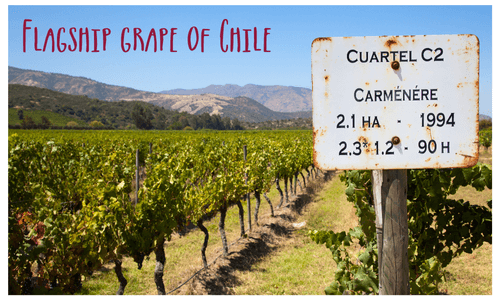
Vineyard of Carmenere grapes in Chile with caption Flagship grape of Chile The Carmenère grape is a late-ripening variety and so requires a warm, sunny climate and a long-growing season to thrive. This limits where it can be successfully grown. The grape is most planted in Chile although this was not by design as described above. In fact, it is now considered to be Chile’s signature grape variety even though it accounts for less than 10% of Chilean vineyards. One of the reasons for this is that Chile was untouched by phylloxera. In addition, being blessed with long, dry summers, Chile, in particular the Central Valley region, provides a very suitable environment in which the grape can thrive. The areas of Chile which have long hot days and cool nights produce the best wine because the grapes can ripen slowly and mature fully whilst retaining good acidity and developing a panoply of aromas and flavours including fruity rather than the green flavours that can come from under-ripe grapes.

Whilst growers have tended to find the sunniest, warmest spots for Carmenère in order to get round the ripening problem, now they are looking for areas with a warm climates and moderating breezes in order to exhibit the grape’s best varietal characteristics in its wines.

Carmenère is a variety that is being planted increasingly elsewhere but reliable figures on the number of hectares in each country planted with it are hard to come by because there of the confusion about the grape. Carménère is grown in small quantities in countries such as China, Italy, Argentina and the USA, largely in California. In fact, it is argued by some that China now grows more Carmenère than Chile but it is difficult currently to establish how true this is.  A few vines exist in Bordeaux and Carmenere is still named as one of the six permitted black grape varieties in that region.

Styles of Carmenère wine

Though at relatively low levels compared to the big-gun black grapes like Cabernet Sauvignon, Merlot and Syrah, production of Carmenère is increasing slowly. More importantly perhaps is that its wines are improving as winegrowers now recognise the grape and the need to ripen it fully to show it at its best. But there are a number of styles and price points worth considering.

Entry-level Carmenère is still dominant. These basic, easy-drinking wines can be juicy and fruit-forward – but be careful at the lower price points of one-dimensional, commercial style wines. As mentioned above, if not given sufficient time to ripen, Carmenère grapes produce wine that can taste green or stalky with strong herbaceous characteristics.

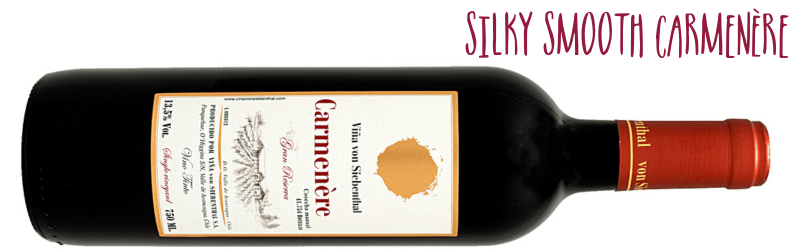
Reserva and Gran Reserva Carmenere wines like Von Siebenthal Carmenère below are aged in oak and, whilst still fruity, develop spicy characteristics, a smoother mouth-feel and structured tannins. Some caution is required because, without careful management in the winery, wines can be too high in oak, alcohol and tannins making the wines more rustic than they need to be. Well-made Carmenère should be more complex and show a good balance between sweet fruit, savoury and spice flavours, alcohol, tannins and acidity. The best wines will also be age-worthy.

What Carmenère tastes like

So how does Carmenère taste? Despite all the confusion with Merlot, Carmenère wine shares a lot of the characteristics of Cabernet Sauvignon. It is

  • fairly deep in colour, tending towards deep purple
  • moderately high in tannins which give the wine some backbone but also a rounded, velvety texture
  • a medium to full body
  • decent levels of acidity to ensure the wines have a freshness to them and
  • relatively high alcohol.

It usually has a smooth texture and is more often than not barrel fermented and aged. It is versatile and can be produced as a single-varietal wine or blended with grapes like Merlot, Syrah and Cabernet Sauvignon, adding deep colour, fruity and spicy flavours to the blend.

Carmenère has so much more to offer: a well-made example will be complex, with a silky mouthfeel, balanced soft tannins, oak and alcohol and highly concentrated perfumes and flavours. The profile of a good Carmenère includes:

  • predominantly black fruits – sweet black plums, blackberries, blueberries – and sometimes raspberry and cherry with
  • spicy undertones – black pepper, smoky paprika, bay leaves and sometimes notes of clove and cinnamon.
  • herbal notes including red peppers and sometimes mint or eucalyptus. There may be a hint of green pepper but more than a hint may mean that the grapes have been picked before fully ripening.
  • Effects of oak-ageing in notes of dark chocolate, tea, vanilla and hints of tobacco and tar in more mature examples. Oaked Carmenère especially is multi-layered and complex.

The best wines are made in a more elegant style retaining the succulent dark fruit and pepper. If you see Gran Reserva or Reserva Especial on the label, this will mean that the wine has been aged for longer than average and will be produced from the best grapes.

Perfect food pairings with Carmenère

Thanks to its balanced acidity and gentle tannins, Carmenère pairs well with a wide variety of dishes but let’s get more specific. Given its similarity to Cabernet Sauvignon, any food that matches well with Cabernet should match well with Carmenère, like grilled and roasted red meats like steak, roast beef and roast lamb.

My fundamental tip for food and wine-matching is that the intensity of a dish should be matched with the body of the wine. This means therefore that the relatively complex and intense Carmenère can cope with quite strongly flavoured dishes.

Given its often earthy nature Carmenère can be drunk with hearty food like beef stews, lamb casseroles and cured meats. And because of its spicy characteristics, spicy dishes also work well with this wine, dishes such as goulash, smoky barbecued meats, chilli con carne and mild to medium curries. Olly Smith has also written about how well the Viña von Siebenthal Carmenère goes with curry: “Aromatic, plump and layered with delicious spice to champion curries all-round from masala to madras. Awesome.” But be cautious if your Carmenere has high tannins as they might clash with chilli.

Carmenère can also make a great pairing with aged hard cheeses like mature Cheddar, Manchego and Comté and its peppery notes make it a good match for many vegetable dishes, for example roasted vegetables, stuffed peppers and mushroom risotto.

When & how to drink Carmenère

A good Carmenère can be kept for about 5 years, longer if it has sufficient tannins, fruit and acidity. Ageing will increase the complexity and elegance of well-made wines. Entry-level versions should be drunk within two to three years of release.

Serve it at 16-18°C to get the best of those complex aromas and flavours. If the wine seems a little closed, then decant to open it up or swirl your glass.

Why try Carmenère?

Red wine being poured from the tip of a bottle into a large glassThere are so many reasons why you should try Carmenère:

  1. You should definitely try it if you are a fan of Cabernet Sauvignon – you might be very surprised – but also if you like fuller-bodied, more intensely flavoured, spicy red wines like Cabernet Franc and Grenache.
  2. Good Carmenere has a unique complexity with fruit, spice and savoury characteristics
  3. Its tannins generally soften more quickly than some other big red wines making it more approachable at a younger age
  4. It is a good food wine – but also a lovely glass on its own
  5. It is good value as it is still relatively unknown
  6. It sums up Chilean wine in a glass

The future of Carmenère

It is a very interesting time for this black grape; its revival continues with the promise of interesting developments still to unfold.

Producers in Chile especially are torn. Some want to keep Carmenère to add to blends – most frequently it is blended with Cabernet Sauvignon and or Merlot. It may be an idea to try a blend for your first foray into Carmenère.

But there is potential for better things. Since Carmenère is still relatively young as a recognised variety, many winemakers are keen to learn more about how to produce it better (it is not an easy grape variety to grow) so that they can create a national wine on a par with Argentina’s Malbec. Experiments with different terroirs, climates, soils and wine-making techniques continue making Carmenère definitely ‘one to watch’ over the next few years. With its distinct flavour and complexity, this grape is likely to gain more global recognition in the years ahead.

Cheers!

I am passionate about good quality wine and set up Wines With Attitude to share that passion with other wine lovers. If you’re feeling sociable why not follow me on social media or share my blog with others?

independent producers

personally chosen

especially for you

07349 886389

hello@wineswithattitude.co.uk

Love wine?

Sign up to my newsletter to receive exclusive offers and learn more about Wines With Attitude

You have been successfully Subscribed! Ops! Something went wrong, please try again.

© 2014-2025 Wines with Attitude Ltd | VAT Reg. No. 181 2419 22 | Registered in England 08918466 | Fiveways, 57-59 Hatfield Road, Potters Bar, Herts, EN6 1HS