The sparkling wine industry in the Penedès wine region of Catalonia in Northern Spain where most Cava is produced has been the scene of in-fighting for a number of years. This blogpost looks at the history of Cava and the most recent developments in the Cava DO appellation, including how Cava has changed its categories of Cava and its labelling. In addition it considers the alternative Spanish sparkling wine formats that have emerged in competition with Cava, Classic Penedès and Corpinnat and what the future may hold for these competing Spanish sparkling wines.
After the phylloxera epidemic destroyed European vines in the late nineteenth century and the only way to keep producing wine was to plant American species or graft European vines onto American rootstock, many red wine producers in Penedès decided to switch to growing white indigenous grape vines, grafted onto phylloxera-resistant rootstock. The main driver for this change was the burgeoning sparkling wine industry in the region; in 1872 the traditional or Champagne method of producing sparkling wine had been introduced to the region and was seeing some success.
The name Cava was first used for all the region’s sparkling wines from 1959 but it was only in 1986 that the name “Cava” was applied only to sparkling wine made by the traditional or Champagne method in the region then legally and formally recognised as the Cava appellation. This coincided with growing demand for sparkling wines from an increasing number of markets overseas.
I first wrote in 2016 about a quiet revolution that was then taking place in the Penedès region, where most Cava is produced. The revolution had come about mainly due to the success of the Italian sparkling wine, Prosecco, which had positioned itself as the value alternative to Champagne in many markets including, indeed mainly, in the UK. As a result, most Cava producers seeing a potential reduction in their market had started to fight back, in many cases adjusting their Cava to match the lighter style and cheaper price of Prosecco. But this was considered by many to be to the detriment of the Cava brand which gained a pretty poor image as a flood of volume-focused, low-priced Cava soon became the predominant style.
A bigger revolution was to come however as some producers of top end Cava rebelled against this commercial style of Cava and exited the Cava DO appellation.
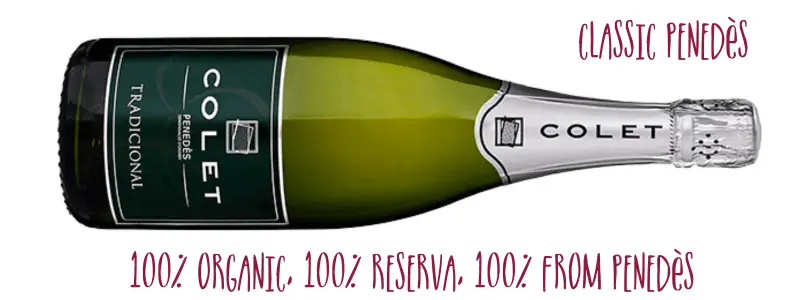
A group of c. 17 producers including Colet, whose Tradicional Extra Brut Classic Penedès I stock, moved their higher-end Cava out of the Cava DO and into the Penedès DO. This DO covering still and sparkling wines had been in place for a long time but a new category or brand was created in 2014 specifically for sparkling wine called Classic Penedès, high quality Cava by another name. These producers wanted to distance themselves from “standard” Cava and they set themselves some pretty high standards which were incorporated into the Penedès DO regulations.
The factors that would differentiate the Penedès DO sparkling wines from Cava were that they had to be:
Quite a few grape varieties are permitted in Classic Penedès including several international grapes though the core varieties used are the classic Cava varieties, Xarel-lo, Macabeo (also known as Viura) and Parellada.
There are as at the end of June 2026 13 Classic Penedès producers including Colet. In 2024 one million bottles of Classic Penedès were produced.
Corpinnat sparkling wine
Between 2015 and 2017 another group of Cava producers who were also trying to distinguish their wines from Cava set themselves up in a collective with a brand name, Corpinnat. Their aim was to create terroir-based Cavas. The name, derived from Catalan and Latin words, means “Born in the heart of Penedès”.
In 2018 the then eleven-strong group moved out of the Cava DO which refused to allow them to have both Cava DO and Corpinnat on the same label. The brand name is found in the middle of their wine labels and aims to distinguish high quality sparkling wines that are:
They go a step further than Classic Penedès by requiring ageing in bottle for a minimum of 18 months. Some of their sparkling wines are aged for more than 30 and even 60 months.
Corpinnat has made a commitment to phase out the use of non-indigenous grape varieties by the 2035 vintage.
There are as at the end of June 2026 23 Corpinnat producers. In 2024 2.2 million bottles of Corpinnat were produced, more than twice the number of Classic Penedès bottles produced
How Cava is fighting back
With these two major developments, it is no surprise that the Cava producers worked on ways to fight back.
The Cava Regulatory Council started out by promoting ‘premium Cava’ to encompass the following styles of Cava which were expected to account for approximately 30% of all Cava:
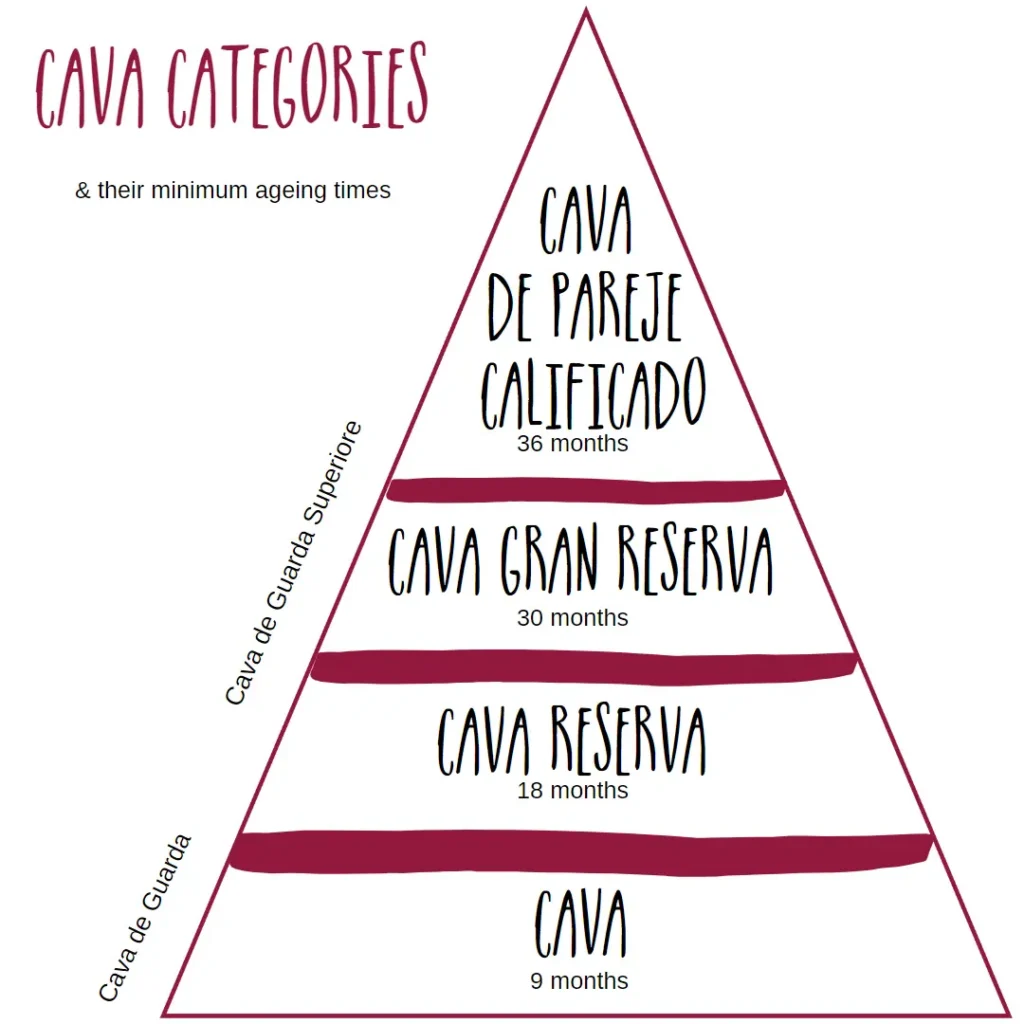
In 2020 the Cava Regulatory Council formalised the categories based on how long the wine is aged in bottle and the more detailed regulations and categorisations are as follows:

Cava de Guarda must be aged for a minimum of 9 months. This younger style is according to the Cava DO “fresh, fruit and full of vitality”. Expect a crisp wine with acacia, apple blossom and apple aromas and flavours and a hint of aniseed.
Cava de Guarda is recommended to drink with sushi, seafood ceviche, guacamole and dishes with fresh mint.
Cava de Guarda Superior must be aged in bottle for a minimum of 18 months to add complexity and from 2025 must be produced 100% from organic grapes. This category is split into the following sub-categories:
– Cava Reserva, aged for a minimum of 15 months (potentially being increased to 18 months) with floral, light toast and aniseed aromas, still fresh and fruity in the mouth (peach, apricot and apples) but with added complexity and a slightly bitter finish.
Cava Reserva is recommended to drink with seafood ceviche, lime flavoured dishes, corn, popcorn, nuts, fatty meats, salmon and Mexican cuisine.
– Cava Gran Reserva, aged for a minimum of 30 months is described by the DO as “the ultimate in complexity”. It will display aromas of baked apples, dried apricots and nuts with some toasty and smoky notes. The longer ageing will make the texture silkier.
Cava Gran Reserva is recommended to drink with jamón ibérico, parmesan cheese, miso, mushrooms, dark chocolate, fajitas and with a traditional Christmas turkey dinner.
– Cava de Pareje Calificado, loosely translated as Cava from a qualified location, must be aged for a minimum of 36 months. These are essentially vintage Cava wines from vines that are at least 10 years old from single vineyards in the best ‘terroirs’ of the Cava region. Wineries producing these Cavas have to produce 85% of their own base wines. Given the terroir focus of these wines, each will taste different though all will have even more complexity in their aromas and flavours and a creamy texture.
By the end of 2025 only 15 Cavas had achieved Cava de Pareje Calificado status. Cava de Pareje Calificado calls for more complex dishes and strong flavours especially truffles, blue cheese and sesame-flavoured dishes.
Note that rosé Cava is produced in all categories except for Cava de Pareje Calificado and accounts for just over 8% of total Cava production.
All Cava categories can be produced with different levels of sweetness although Cava Gran Reserva and Cava de Pareje Calificado are restricted to the drier end of the spectrum – Brut Nature (0-3 grams per litre of residual sugar), Extra Brut and Brut (maximum 12 g/l residual sugar) – whilst Cava and Cava Reserva can range from Brut Nature through to Dulce (over 50 g/l residual sugar).
In 2020 the Cava Regulatory Council, in response to criticism of the extensive area previously permitted to produce Cava, introduced new zoning with four main zones, Comtats de Barcelona, Ebro Valley, Vinedos de Almendrejo and Levante. Whether this move has actually reduced the permitted Cava region is unclear, however it did aim to take into account specific terroirs and microclimates by the creation of several sub-zones within two of the four main zones, Comtats de Barcelona and Ebro Valley. It is still under debate whether this move has shut off criticism about the lack of terroir-specific Cavas.
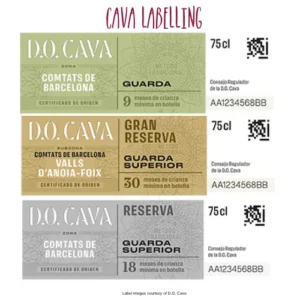
A little reminiscent of Rioja labels, Cava’s new quality seals were launched in order to identify the different categories of Cava and to provide a guarantee of the origin of the wine and a guarantee that all technical regulations for that category have been met including the use of only those grape varieties authorised.
In addition in 2020 a new “Elaborador Integral” (or Integral Producer) label was created for use by producers who carry out the entire Cava production process themselves, instead of buying wine for Cava made elsewhere. By the end of 2025 there were 19 wineries entitled to use this label.
A four-pointed star on the cork is also a symbol of Cava’s authenticity.

It is a shame that all producers could not come to an agreement on the regulations and categories of sparkling wines made by the Champagne method in the Cava region. It’s hard to keep track of all the differences between Cava, Classic Penedès and Corpinnat which after all are produced from similar grapes (principally the indigenous varieties Macabeo or Viura, Parellada and Xarel-lo) in the same way as Champagne with second fermentation in the bottle.
What is for sure is that sales of Cava are declining. A number of recent droughts and mildew attacks have contributed to this decline but the loss of producers to Corpinnat and to Classic Penedès has not helped. To put things in perspective however Cava sold over 190 million bottles in 2025, Corpinnat over three million and Classic Penedès just over one million.
Although there is slight growth in the Cava Do’s superior categories, bear in mind that approximately 80% of all Cava is produced in the young, “regular” style that is not organic and may come from outside Penedès. If you are looking for the best Cava-style wines, stick to Classic Penedès, Corpinnat or Cava de Guarda Superior.
It seems very unlikely that either of the rebels will move back to Cava DO despite efforts being made there to up their game.
Previous attempts by Corpinnat to work more closely with the Cava DO have been declined with the Cava DO refusing to allow Corpinnat and Cava DO to exist together on labels.
Corpinnat collaborates to a degree with the Penedès DO as you might expect since their aims are very similar. There may well be a move to more closely align their aims – for example, it looks like Classic Penedès may move its 15-month minimum ageing requirement to match Corpinnat’s minimum of 18 months. You can also see Penedès DO and Corpinnat on the same label. But whether Classic Penedès and Corpinnat merge into a separate entity or both become a bigger part of Penedès DO remains to be seen.
Another option for Corpinnat is to push for its own DO or appellation. Some of the Corpinnat producer-members would prefer to have their own sparkling wine region rather than just produce one type of wine from an existing DO – this is a dig at Penedès which is still focussed heavily on still wines. I suspect that we are going to have to learn to live with the differences for some time to come.
With thanks to D.O. Cava, D.O. Penedès and Associació de Viticultors i Elaboradors CORPINNAT
#DOCava #Corpinnat #classicpenedes #dopenedes #organicwine #wineswithattitude #cavaday
© 2014-2026 Wines with Attitude Ltd | VAT Reg. No. 181 2419 22 | Registered in England 08918466 | Fiveways, 57-59 Hatfield Road, Potters Bar, Herts, EN6 1HS